
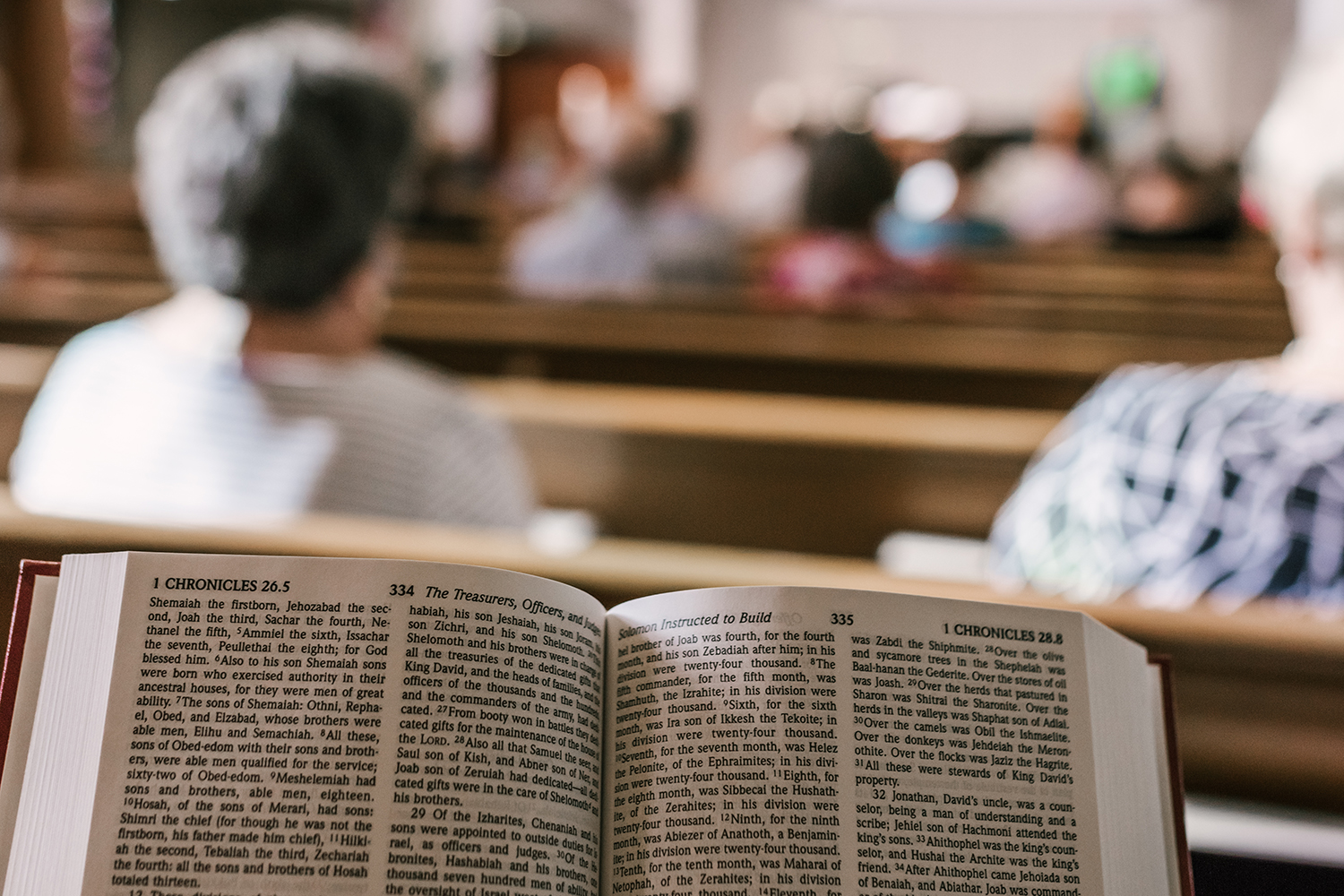
This is always a special Sunday in the rhythm of our life together as a church. It’s a day marking endings and celebrating new beginnings. For the youth who committed to confirming their faith this year, all of their efforts are culminating in this public profession. We celebrate their decision to say “yes” to Jesus and the church, but it’s also a day that marks a launch into a deeper, more vigorous faith. It’s not an ending; it’s a beginning.
The same goes for our graduates. Years of effort have led to this. I’m sure there was a lot of joy along the way, and I’m sure there were disappointments and heartbreaks too. Yet, this is more than an ending. It’s a launch into what’s next, whether that’s working or more school.
The first pastor I served with in Georgia liked to talk about the chapters of our lives, and I loved that image so much, that I’ve adopted it. For many today marks the end of one chapter, and we turn the page to enter the next one. It will hold new adventures and challenges. It’s worth paying attention to how God is writing your story, page by page, chapter by chapter. They all add up to who you are becoming, and I believe that God doesn’t waste any of it. Everything — the great and the not so good — are a part of how God is uniquely growing you.
We had today in mind when the staff began recalling graduation speeches. There are some truly famous ones. In 2005 Steve Jobs told Stanford’s grads, “Remembering that you are going to die is the best way I know to avoid the trap of thinking you have something to lose.”
In 2011, Denzel Washington spoke to Penn. “Fall forward. This is what I mean: Reggie Jackson struck out 2,600 times in his career, the most in the history of baseball. But you don’t hear about the strikeouts. People remember the home runs. Fall forward. Thomas Edison conducted 1,000 failed experiments. Did you know that? I didn’t know that because the 1,001st was the light bulb. Fall forward. Every failed experiment is one step closer to success.”
That same year Stephen Colbert offered this at Northwestern. “If everybody followed their first dreams in life, the world would be ruled by cowboys and princesses.”
As the staff was talking about graduations, it turns out a couple of us had given commencement speeches. Our esteemed Church Administrator, Todd Olson, spoke at his, using Robert Frost’s “The Road Less Traveled” to guide him. He claims there are no existing copies of his speech, but if you press him, he might give you some advice on the road you should take.
I spoke at my graduation, having no idea that I would devote a good portion of my life to speaking publicly. I, too, don’t have a copy of that speech, and I hope there are no recordings. But I can remember the spring of 1996, where the four graduation speakers met to pick a theme. We ended up with the prompt, “Life is like…” This was the era where the vending machine in the school lobby was one of the nicest amenities of our school, but using it could be a frustrating experience. So, I wrote about how life is like a vending machine.
I talked about how often things work out as you expect. You slide your quarters into the machine, press the right buttons, and down drops the bag of chips you wanted. But our school’s vending machine could be unpredictable. Sometimes a perfectly good coin wouldn’t be accepted by the machine, leaving you with no ability get what you wanted. Sometimes it took your money, you pressed the right buttons, the coil turned, and then the chips didn’t drop. You could try shaking the machine, but that could get you in trouble. You could see if someone else had money, so you could press the same buttons, now ending up with two bags of chips, if it worked. The machine, like life, was unpredictable and sometimes unfair. And, of course, there were those kids with skinny enough arms, who could reach through the trap door, snaking their arm up into the lower rows, and stealing what they wanted.
I still love this metaphor for life, although vending machines have changed so much, I’m not sure it would resonate like it did in the mid-‘90s.
Both of our scriptures today remind me of commencement speeches. Over the past few Sundays, we’ve been following Jesus’ final days as told by John, who devoted significant space to how Jesus prepared his disciples for life without him physically with them. The gospels regularly tell us that Jesus devoted time to prayer, but John 17 gives us the lengthiest glimpse into a prayer of Jesus. In this, he prays for his disciples, present and future. That is, Jesus prayed for us, too.
Like a commencement, the disciples are moving from one way of being into a new chapter. As Jesus faces his final days, they have to go from students to those sharing the good news of what God has done in Jesus and building beloved communities of faith. Jesus has completed his work, in his words, “I glorified you, [God], on earth by finishing the work you gave me to do.” But he knows the work continues through these students and those who will follow them down through the years. So, he prays for all who would carry on this ministry, saying, “And now I am no longer in the world, but they are in the world, and I am coming to you. Holy Father, protect them in your name that you have given me, so that they may be one, as we are one.”
Jesus is launching them from one chapter into the new one, and he is equipping them with the Holy Spirit, with his prayers, and with all that he has taught and shown them. The new chapter may feel unknown, exciting, and even perilous, yet we can face it because he has given us what we need.
That first generation of disciples, both in success and failure, did just that as time went on. They traveled from place to place, sharing this world-changing news of Jesus. One of those places it took root was in present-day Turkey. Peter knew the churches there. They faced stiff opposition. They were exiled into places throughout Turkey, places like Pontus, Galatia, Cappadocia, and Bithynia. Peter’s words faced reality, a reality that the message of Jesus was divisive, leading to rejection and even persecution.
I think many graduates look at the future as wide open. They’ll get a job and have money. They’ll go to college and gain knowledge and wisdom that will lead to a full life and a great career. Most don’t think they’ve peaked in high school and that it’s all downhill from there. And while I hope that all of us are looking towards a brighter future, I also know that life doesn’t always break for the good.
My older brother also spoke at his graduation, and their theme was famous quotes. He chose a portion of Ecclesiastes from the Bible, and the theme is seared in my mind because even then I found it running headlong into my naïve belief that everything should be rosy for someone who loves Jesus. Here’s the quote from Ecclesiastes:
“Again I saw that under the sun the race is not to the swift, nor the battle to the strong, nor bread to the wise, nor riches to the intelligent, nor favor to the skillful, but time and chance happen happen to them all.”
Ouch. How’s that for motivational?
Yet, isn’t there comfort in facing reality — that life isn’t always fair, that things will go wrong — and saying that God is there in the brokenness and failures, too? That we have a calling that is higher than filling our bank accounts and having the perfect house and family? Peter is writing to his beleaguered brothers and sisters in Christ with the determination that God is comforting them in even in the hardest of circumstances.
So, Peter’s letter closes like a commencement speech, offering wisdom on how to live wisely in a world that can be hostile to the work of God. I highlight those that wisdom for the whole church, but thinking particularly about our confirmation students and graduates, who are moving into a new chapter in their lives. Here’s Peter’s (and my) advice to you.
Humble yourselves before God, and he will lift you up. Humility is in short supply these days. Influencers curate their lives to make it look like they’ve got it all figured out. Cockiness gets attention. The loudest voice grabs the news cycle. Yet, it’s vital to learn humility from God, who has lived this out. Imagine you were all-powerful, creating everything, and yet you decide to heal the world by becoming a baby. Humility is a powerful, subtle force. Walking into a room and announcing that you’re the greatest is one of the surest ways to fall on your face. Embracing humility allows others to see who you really are and lets them elevate you. Be humble.
Next, Peter encourages us. Cast all your anxiety on God, because he cares for you. We hear all the time about how anxious our world is. We worry about our future. We worry about our health and about our loved ones. Anxiety and worry in healthy doses are signs that we care, but they can overwhelm us if we try to carry them alone. God cares for you. Isn’t that great news? God isn’t absent in the trouble; God is with you. So, when you are anxious, pause.
Offer your anxiety to God. He cares for you. He is with you.
Then Peter offers, discipline yourselves. Keep alert. Resist evil. Notice how all of these are active verbs. Trouble will come, but being prepared for it with God’s help will give us the upper hand. Discipline means taking what we’re learning about God — through confirmation, through worship, through personal study — and seeing how that applies to how we live. It’s being alert and alive both to the goodness and to the wickedness all around us. It’s actively saying “no” to the forces of destruction, so that we can be God’s “yes” to being agents of God’s loving kindness. It’s about putting God at the center of our existence, and moving ourselves out of that center.
But why? Because life is a mixed bag. It’s not all good. It’s not all bad. Suffering will come. Remember time and chance happen to us all. Yet, God promises a good end. We hold fast to those promises, which give us strength enough for today and bright hope for tomorrow.
Friends, we’ll all face many new chapters in our lives. Whatever is written for us in those chapters, know that God is always with us, loving and challenging and spurring us along the path that leads to life.