
As some of you may know, we are in the process of remodeling our kitchen. I’ve never been through a renovation like this before, and I quickly learned you don’t simply pick out white cabinets or a countertop. You have to think about how textures and colors come together.
I also learned that white isn’t just white. There are warm whites and cool whites. And one’s backsplash needs to be the right color of white to complete the “feel of the kitchen.” Warm tones can make a white kitchen feel warmer with its beige and brown undertones. Cool tones tend to make a white kitchen feel sterile and cold. A tile by itself can’t complete the feel of the whole kitchen, but the right tiles with the right color and undertones can create the right contrast with the colors of your counters and the cabinets, the floor, the hardware etc. to achieve the overall desired feel.
So here is where I’m at after narrowing it down to three different “white” backsplashes after looking at a dozen others. I could use your prayers.
This process of learning how the undertones of color create the right contrast made me think about how the hopeless tone of Ecclesiastes greatly contrasts with the hope the rest of Scripture speaks of. But contrast can help us define what something is. We know what something is by knowing its opposite. We don’t know light without darkness. We don’t appreciate summer without winter. We value life more when confronted with death.
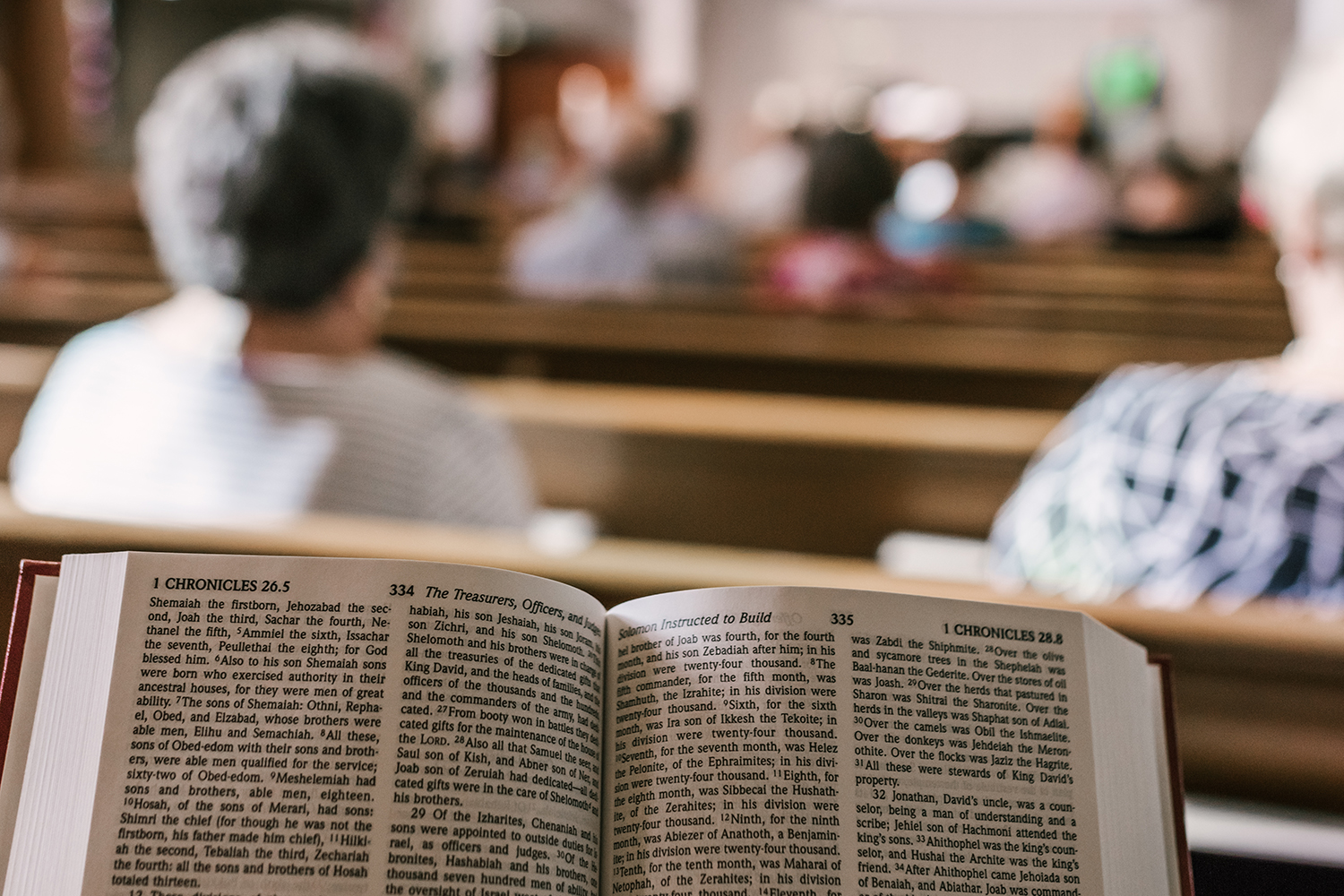
Ecclesiastes contrasts with the rest of the Bible. To quote Biblical scholar Peter Kreft: “Ecclesiastes is the contrast, the alternative, to the rest of the Bible, the question to which the rest of the Bible is the answer. There is nothing more meaningless than an answer without its question. That’s why we need Ecclesiastes. The question Ecclesiastes asks is “What’s the point?”
Why toil? There is nothing new under the sun. And Is anyone remembered for their toil? The author admits to gaining knowledge and wisdom, but even then he describes it all as “meaningless.” And that once you’re gone, you’re gone and no one will remember you.
What I love about the Bible is that it’s real. Holy Scripture does not shy away from real human emotions. There are times when we do wonder: “What’s the point?” There are times when life and all we do seem to be all for naught.
What I love about the Bible is that through it, God gives us permission to feel whatever it is we are feeling. We see this especially in Ecclesiastes and the Psalms. We see this in our passage today from Hebrews: those mentioned in the “hall of faith” had the gift of deep faith, but this doesn’t mean they didn’t have doubt or experience despair.
Noah must’ve had doubts as his neighbors ridiculed him for building the ark when there was no rain in sight. Abraham, I’m sure had his doubts about leaving everything and everyone he knew behind in order for God to lead him to the promised land. Scripture tells us that Abraham questioned God directly in response to God’s promise that Abraham and his wife, Sarah, who were on in years, would have a child.
When God first called Moses to lead the Israelites out of Egypt and out of years of slavery, Moses refused and asked God to send someone else.
Remember that Jonah sailed in the opposite direction of where God asked him to go. I could go on and on about those who the Bible hold up as the most faithful had their moments of doubt. Yet even in their moments of doubt, God didn’t give up on any of them. God did what God always does and will always do, God remained with them and God will remain with us.
Knowing that God never abandons us gives us hope. Even when it seems like we have no reason to hope. When we know that God’s love and presence will never fail, even when things around us fall apart, our hope is transformed.
Paul agrees with this. In Philippians 3:8, Paul compares all of his achievements, high ranking Roman official, a “Pharisees of Pharisees,” he was the epitome of achievement in every way at that time. Yet, Paul says it all pales in comparison to knowing Jesus Christ. Not that our work isn’t good. But it pales in contrast to what only God can give. Whenever we choose to define ourselves with anything other than God’s love we will be sorely disappointed. Whenever we choose to place our hope in something or someone other than Jesus Christ we will become hopeless.
The author of Ecclesiastes concludes Ecclesiastes with these words in 12:1: Remember God and keep God’s commands. That is what truly matters.
God gives what we do meaning. God gives us meaning period. Jesus Christ is the same yesterday, today, and forever. We change, everyone around us changes, and while the world constantly changes, God stays the same. When our plans don’t pan out, when we lose those we love, or we are burdened with deep disappointment, we are not alone. We are not abandoned. To God, we still matter and always will.
Christ’s love and presence with us is the same as it was when life is great (we’re healthy, our loved ones are healthy, our relationships are great, and our careers are going well), and Christ’s love and presence with us is just as constant when life is not great. When our health fails, our careers don’t seem to be going where we want them to go, or our relationships with loved ones are tenuous. In all of the above, God’s love for us remains unchanged.
In the book of Jeremiah, Israel is in exile after being conquered by the Babylonian Empire. They were ripped from the land God had given them and on which generations built livelihoods, families, and community. Israel had every right to give up. To give into despair and hopelessness. Instead, they are commanded by God to plant gardens and eat from them. Get married, have children, continue to create families. Continue to create a strong community with all of your neighbors, not just with Israelites, but yes even the Babylonians. (Jeremiah 29:5-7).
In exile, Israel had to redefine hope. In Hebrews 11, faith is defined by “assurance in what is hoped for and certainty in what is not seen.” Israel no longer had hope in a strong royal dynasty and its own land. But what did happen is that their hope was transformed in that they were able to see God’s faithfulness despite losing their royal dynasty and their homeland. They of course lamented over those losses and ways of life, but their hope in God was no longer dependent on their type of government or what land they owned. Their hope was in God period.
God is always in the business of making all things new. Only Jesus Christ can bring good out of terrible circumstances. It may take a while for us to see that, but thank goodness Jesus doesn’t wait for us to recognize he is at work before he brings good to our lives and the world. He brings good even in the darkest of situations. And to be clear, God doesn’t purposely bring darkness and calamity into our lives so that we see God’s goodness, but rather, God brings about goodness in the midst of the darkness and calamity we experience. I hope you see the difference.
So what is the point? The point is that we can always have hope in Jesus Christ who never changes. Who always remains faithful. Who will always bring about goodness and light in the darkest of places. We may not see it right away as God does not work according to our timelines. Moses, after all, never entered the promised land and neither did Abraham. But the promised land was never the ultimate goal. God gave them something more valuable. Hope. Hope that God’s love is unchanging, constant, and always at work. Whether we are living in the promised land or in exile. Whether we are experiencing joy or lament. Whether we can see the light or are blinded by darkness.
The author of Ecclesiastes was right. There is nothing new under the sun. Even during biblical times the most faithful had their moments of despair and doubt. The same can be said of us today. But just as God transformed their hope, God transforms ours as well so that we are more confident of God’s presence and love with us always.