
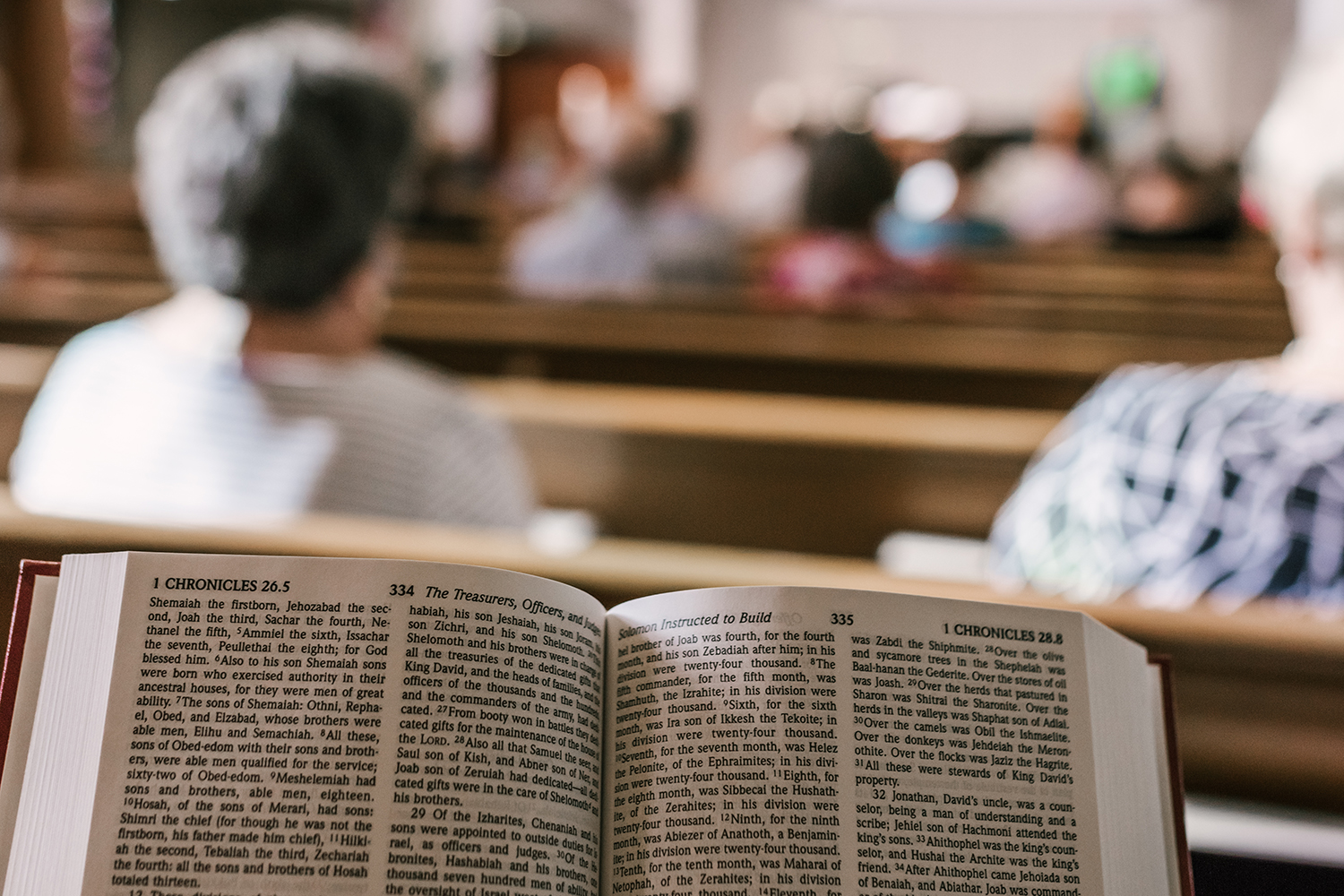
Back when I was in seminary, the popular pastor and author, Erwin McManus, came to speak at our school. He was one of the leaders of the Emerging Church movement, which, to oversimplify, was driven by shaking free of things that looked or felt too churchy. The movement believed that things like organs and fancy buildings were an impediment to faith. McManus was well-known, so many went to the chapel to hear him speak.
Miller Chapel is a nice building — very simple and austere, in good Protestant fashion — but in it sits the Joe R. Engle organ (yes, it’s named). It fills the entire back of the chapel. So, there’s McManus, guru of the Emerging Church sharing his story and vision with us, when, all of the sudden, he stops. He turns and stares at the organ. He turns back to us and says, “Do you know what I see when I look at an organ like this?” He paused. And then dropped his bomb. “Firewood.” (Sorry, Rob!)
Now, while I don’t think it’s necessary that all churches have stained glass, fancy architecture, pews, and organs, I do think that a beautiful, thoughtful building can shape ministry positively. These days many churches have given up on this, opting for warehouses and auditoriums, which are very much a reflection of their theology and also very practical. And I say that without judgment because there are times that our sanctuaries and other things that ring bells of old-time religion have gotten between people and Jesus.
But that also doesn’t mean that a thoughtful, artful space can never inspire faith. We’ve taken this whole fall to engage with the stained glass of this sanctuary because it’s something that inspires faith, that can cause us to learn more about the stories of our faith, and that can surround us with reminders of God’s great love for the whole world. I hope that’s what we’ve done — that these windows are pointing to something beyond themselves — because if it’s only been about the windows, then we’ve wasted our time doing some sanctified navel-gazing.
I hope that this has been a time of opening your eyes to see Jesus more clearly, to understand God’s love for you and for the world more deeply, and to find gratitude that God surrounds us with messages of grace everywhere. Those who designed this sanctuary in the 1950s were hoping that was the case. The booklet published to give a guide to the building says as much.
It begins, “The building of a church is vastly different from the building of a home, store, factory or other type of public building….The symbols within a church are…unique. When we build a house, we use decorative effects for their beauty alone. But in a Church, they are also used for the religious story they tell or for their significance in our Christian heritage.” The booklet goes on to describe all sorts of elements on the exterior of the building, so it’s a worth a read if you’ve never given them much thought.
The writer then concludes, “This, then, with God’s help, has been the Great Endeavor:
To provide a church which invites and inspires men and women to worship;
To portray — in stone and wood…in metal and glass…the reminders of our Christian heritage;
To build with human hands a dwelling place for God;
To offer a sanctuary where a Christian may come during earthly trials to be inspired by the Heavenly;
To provide a House of Worship, where — in words of our dedication statement:
The faithful may find salvation, and the careless be awakened.
The doubting may find faith, and the anxious be encouraged.
The tempted may find help, and the sorrowful comfort.
The weary may find rest, and the strong be renewed.
Where the aged may find consolation, and the young be inspired.”
In other words, this is a place carefully designed where the divine and the human meet. In Celtic spirituality this is known as a thin place, where the veil between heaven and earth is so sheer that we can taste, touch, feel, and see that God is here with us, that all we do with our lives that feels so mundane — the chores, the work, the school — is actually done in a world that is filled with the glory of God. This sanctuary is designed to make the presence of God obvious and available to us.
We’ve taken the past three months to look intently at these windows. We began with the resurrection window above the chancel. Many churches built in this style give focus to the death and resurrection of Jesus in this window because it’s the core of the gospel. When you enter the sanctuary, this window is what draws your attention. There’s the risen Jesus, surrounded by angels trumpeting the good news that Jesus has conquered death and opened the door to salvation. Jesus, risen from the dead, is now crowned king. This window is enough to come to a basic understanding of our faith, and that’s why it’s there.
But today’s window — the facade window — bears a message that takes things to the next level. It’s placed in the rear of the sanctuary because you’re supposed to see it as you are leaving worship and reentering the world. The window is focused on Jesus, king of all the world, reigning and ruling over everyone and everything. The window shows Jesus as a compassionate Savior who is stretching his arms wide to welcome all of humanity to his kingdom. While he’s not wearing a crown, it is clear that this window is staking the claim that Jesus is reigning in the world both inside and outside of our sanctuary.
There is Jesus, standing in front of the cross-shaped waters of baptism, those rivers of gladness that welcome and wash clean all who would come to Jesus. His arms are spread wide; his hands stretched out in welcome. Today we read Jesus’ words from Matthew about discipleship. “Come to me, all you that are weary and are carrying heavy burdens,” Jesus says, “and I will give you rest. Take my yoke upon you, and learn from me; for I am gentle and humble in heart, and you will find rest for your souls. For my yoke is easy, and my burden is light.”
If you look behind the chairs in the balcony, you’ll see that verse depicted. Below Jesus’ feet is a red yoke, the equipment that a pair of oxen use to plow a field together, but the yoke was also what a student of a rabbi took on as they learned from him. This yoke has wings on it, reminding all who would come to Jesus that following in the way of him takes our restless souls to a place of peace and lightness.
What I’ve loved about covering our windows is that they are artistically and biblically rich. Every window seemed to have at least a half dozen scriptural references that orbited around a theme. This window, too, is artistically and biblically rich, but it’s really focused on one idea, and it is this: Jesus is reigning and calling all to receive this good news. More so than our other windows, this one is about what Jesus means to us today.
Here we see people standing in for those who would attend this church right here in Grand Haven. There’s a farmer and a military officer. There’s an older man with a cane and a younger woman carrying laundry. There’s even a young boy carrying the Grand Haven Tribune under his arm. I find it interesting that he’s the only one barefoot like Jesus, and I wonder if this is another echo of Jesus’ welcome of the youngest into the arms of faith, a theme found in several of our windows.
There’s a nurse and a mechanic. There’s a professional carrying a briefcase and a mothering picking up her child. There’s also an artist with his eyes fixed on Jesus. At the very least, this is a reminder that our finest creative expressions can happen within the context of faith, but some have wondered if, perhaps, this is the stained glass designer himself in our windows. Who knows? I love that it just might be him.
Bordering the entire window are symbols of the trades and professions of people in Michigan. How many churches have stained glass that includes chemistry sets, radial saws, lamps, wrenches, milk jugs, farm tools, a welder’s torch and goggles, typewriters, fishing nets, and trumpets? This window is a celebration of what it means to be God’s people in this particular time and place. It shows how Jesus calls all of us, whoever we are and whatever we do with our lives. One of the things I most love about the Reformed Christian faith is that it believes that God’s calling extends to every area of life, including our homes and workplaces. We take our writing and music-making, our work in chemistry and in garages, our unpaid labor at home and our service to the community, and we bring it all to Jesus.
But the window goes well beyond this corner of Ottawa County. Yes, Christ is calling all who would come to the church right in this small corner of the earth, but he is also calling everybody to receive this gift of eternal life. Jesus stretches his arms out to the whole world, inviting them to enter into a relationship with him. This Christ is ready to welcome and comfort all the people of the world, starting with us right here in Grand Haven.
While we don’t always emphasize this, our church does follow the Christian year, which is different than all of our other calendars. Starting next Sunday, we begin our year again with Advent, our focus going to the coming of Christ into the world. It’s that season that prepares us to welcome Jesus into our lives at Christmas. Sunday after Sunday, the year moves along, telling us the story of God’s work in Jesus. It culminates in this Sunday, which is the last Sunday of the Christian year. It’s called Christ the King Sunday.
I had assumed that Christ the King Sunday had been around for hundreds of years, but my assumption was wrong. This year marks 100 years since Pope Pius XI established the feast day of Christ the King. In December 1925 as he was establishing it, he quoted Cyril of Alexandria (from the 5th century), noting that Jesus’ kingship was given to him by God the Father and not achieved by violence. Cyril said Christ “has dominion over all creatures, a dominion not seized by violence…but by his essence and nature. From this it follows not only that Christ is to be adored by angels and [people, and that he rules over angels and people.]”
The pope established this feast day in responding to the upheavals from the aftermath of World War I, where between 15 and 22 million people died. That war also brought to an end the four major monarchies on mainland Europe. It was a turbulent time, and the church was relying on theology to remind people of the truth that Christ is King, no matter what is happening in the world around us. His reign is something we trust in, even when so much seems to be falling apart.
And that, dear friends, is why worship matters. Sure, God calls us to worship and desires our worship. But even more than that, worship is this act that recenters us on the truth of the gospel. It reorients our lives, which become disordered throughout the week. It’s why worshipping regularly matters to us individually and communally. I cannot emphasize that enough. When we miss out on sharing this gospel story in worship, we begin to listen more to other voices that lead us from the path of life.
I’ll close with the words of dedication of this sanctuary. We built all this “to provide a House of Worship, where:
The faithful may find salvation, and the careless be awakened.
The doubting may find faith, and the anxious be encouraged.
The tempted may find help, and the sorrowful comfort.
The weary may find rest, and the strong be renewed.
Where the aged may find consolation, and the young be inspired.”
And I might add, to provide a place where we share the story of God’s love for the world that is so great that we leave this place overflowing with that love that we might share it everywhere we go.